


 Down at the river working on a (semi) new project. Hopeful it'll be seen (prominently!) sometime after the New Year. Will let you know.
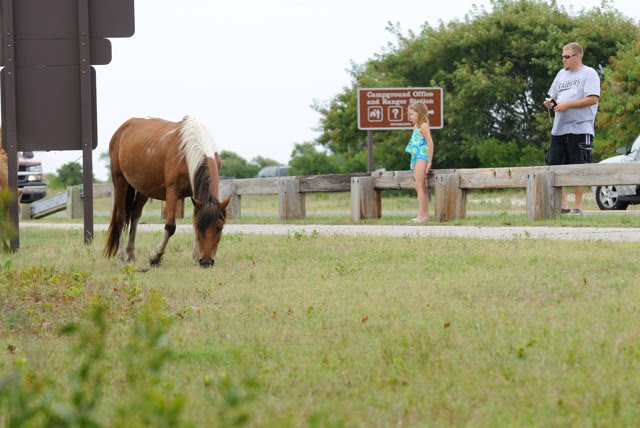
Case in point... a recent visit to Assateague National Seashore where the main attraction are the wild horses. Descendants of 17th century livestock they are today truly wild. In the Visitor's Center, at the park's entrance and in various spots throughout the entire park, signs warn of the dangers of getting too close to these creatures. Every single driver of every vehicle that enters the park is handed this bright yellow paper from the attending ranger:


So, nobody can honestly claim ignorance here. The cautions and warnings are clear and are everywhere.
Now, it is one thing for you, as an adult, to make up your mind to take a chance, risk getting close. That's your choice. But to allow your child to get close, to even encourage her! Just so you can take a picture? Seriously... WTF! Parents... Stop being dumb asses!


 Lastly, here's what you find at the Park's website.
Assateague's horses are beautiful, tough, and wild. They have learned to survive in a harsh environment. Feeding and/or petting them is detrimental to both visitors and horses. Horses can get sick from human food. Those that learn to come up to the road to beg for food are often hit and killed by cars. Visitors are kicked, bitten and knocked down every year as a direct result of getting too close to the wild horses. Treating wild horses like tame animals takes away the wildness that makes them special. Protect your family by respecting theirs. Give the horses the space they need to be wild.
Bike.
Run.


This was my first triathlon. Photography wise of course... not participating! Although by the end of the event, I felt I had. Keeping up with the athletes in the hot-humid summer air of DC as they transitioned from swimmer to biker to runner made for quite the mini-marathon itself. Kind of fun actually.
Also, as a huge fan of our National Park system it was gratifying to discover that the Washington, DC Triathlon takes place almost exclusively on Park grounds. From the Potomac River near the Memorial Bridge and Lincoln Memorial to the Tidal Basin and Jefferson Memorial to the Washington Monument and the National Mall, not to mention a significant portion of Rock Creek Park, these amazing (insane?) athletes made good use of a small segment of our vast Park system. Yet another reason to maintain generous funding for these treasures.
Great challenge, great venue. Can't wait until next year!
More images tomorrow.
Welcome to the new IMPACT online exhibition, a project exploring the internet as a venue for insightful photographic work. In an effort to remind viewers of the important role photographers play around the world, we invited an array of imagemakers to share galleries on their blogs (like this one) that comprise 12 images representing an experience when they had an impact on or were impacted. By clicking on the links below the IMPACT logo, you can move through the exhibition, viewing other galleries by different photographers. You can also click the IMPACT logo to be taken to a post on the liveBooks RESOLVE Blog where you can see an index of all participating photographers. We hope that by linking different photographic visions of our first topic, "Outside Looking In," we can provide a multifaceted view of the topic as well as the IMPACT individuals can have on the world around us.
 | ||||
 |  |  |  | |
| Get Your Free Web Ring Webring by Bravenet.com | ||||

“I had been doing nothing but sitting around watching too much TV. Wasting away,” a soldier once told me. “And one day I saw this guy walking down the hall with a kayak over his shoulder. And he calls out, ‘Hey, whattaya you doing? Want to learn how to kayak?’ This got me off the couch. Gave me something to look forward to.”
It starts in the pool. Getting in the kayak and finding your balance. Learning proper paddle technique, getting used to how it feels to be upside down in the water and learning to roll (which is a way of righting yourself after being upended by using your torso and paddle).


Joe Mornini was the guy with the kayak. A high school teacher and an avid, experienced kayaker, he created Team River Runner to help veterans at Walter Reed Military Hospital rehabilitate. Six years later the mostly volunteer organization continues to give veterans an opportunity to learn new skills and experience new adventures along the road to recovery.


Everybody is meeting in the parking area across from Old Anglers Inn in Potomac, MD. A van filled with boats and equipment is quickly swarmed by volunteers and veterans. Someone is passing out helmets, PFDs (personal flotation devices), paddles, and kayaks of various sizes and shapes. There is much joking and laughter, lots of hugs. It seems everyone is assisting everyone in the preparation to paddle. Angler’s put-in is where the weeks of training in Walter Reed’s indoor pool pay off.
Among those ready to hit the water are a Vietnam vet who lost both legs to a landmine—he has a kayak specially fitted with two leg “sockets”; an Iraq War vet who spent a week in a coma after an IED explosion, and another who lost the use of his right lower leg after being shot with an AK47 – his leg was later amputated below the knee; and several PTSD patients on their first river outing.


The newer kayakers will practice paddling and rolling techniques in the calm waters of the C & O Canal. The more experienced group ventures down to the Potomac River for a little playboating at Maryland Chute or Offutt Island. Their rolling techniques are quickly put to real-world test as they try to surf the waves or “holes.” One wrong move and the kayak flips and is spit down river. One must either right oneself… or swim. You then paddle back into position and get back at it.


Recovery is slow and arduous. But the commitment, tenacity, perseverance, and attention to detail that was required in the military clearly serves them well here. From hospital bed to pool to canal to whitewater, these vets, these Wounded Warriors, exemplify that extraordinary human capacity to overcome.

Just off the C & O Canal towpath, south of the old Tavern Visitor Center in Potomac Maryland, there is a raised boardwalk with a series of footbridges that leads to Olmsted Island. At the end of the walk is an overlook which affords a spectacular view of Great Falls. Protecting rare plant species found only in this unique habitat by concentrating all foot traffic in one place, the 1/4 mile long boardwalk and the overlook embody the spirit of conservation expressed in the above quote. It is a very small footprint upon this large yet fragile landscape. Thanks to Mr. Olmsted and like-minded others and their inspired words and deeds, future generations will be able to enjoy all the many and various aspects of our National Parks, including this island, the flora and fauna within, and that wonderful view of those turbulent falls.
The images below are a small representation of this area. All were shot from either the boardwalk or the overlook.


On a recent trip to Grand Teton National Park I was privileged to see with my own eyes a level of stupidity that only the Darwin Awards committee could appreciate. A remarkable number of people treated the animals -- bears, elk, moose and the like -- as if they were tame, game-park creatures. The complete lack of respect for the wildness of the park's wildlife was shocking. The potential for carnage and mayhem seemed ever present. Maintaining a safe distance and quiet tones of voice while viewing wildlife appeared to be an utterly foreign concept to far too many individuals. Large scrums developed almost instantaneously roadside whenever an animal was spotted. Parents with small children ran up screaming wildly at the black bear with her cub. A black bear and her cub! No kidding. Not only does behavior like this shatter an otherwise moving experience for many, but it also places everyone in danger by potentially irritating mama bear. In addition, the cars and SUVs left idling, parked haphazardly along the road created traffic jams that rangers constantly tried to clear. (If they happened by.)
It was pure luck that no one was gored by a bison or turned into a tasty treat by a grizzly that week, and I have the impression that few people learned anything. But the animals in our National Parks are not tame. They may appear that way sometimes because they seem to tolerate the presence of humans to a degree. But ultimately they are wild. And dangerous! Respect that.
Man and beast will cross paths in the parks, that's just the way it is. However, simple things like staying in your car or keeping a safe buffer between you and the animal (and using your indoor voice!*) would go a long way to avoiding many tragic (and near tragic) encounters.
Below are a couple examples of near tragedies. (click on the links)
http://www.nationalparkstraveler.com/2007/06/grizzly-attacks-man-grand-teton
http://www.youtube.com/watch?v=roMoGNHrrV8&feature=player_embedded
*A quick note about "indoor voices." When in the back country this is not the proper thing to do. If you want to avoid unexpected encounters, speak loudly and don't be afraid of making too much noise. Bears don't want to be bothered by you; if they hear you coming they will move on. If you surprise them, all bets are off!
Cheers.


